Discernment Counseling: How to Decide If Divorce is for You

Should you stay … or should you go? If you’re like most people, once that question pops into your consciousness, the way you look at your marriage changes – sometimes forever. You struggle to make a decision … sometimes for years. Discernment counseling can help you and your spouse get out of indecision and figure out what you want to do with your marriage moving forward.
What is Discernment Counseling?
Discernment counseling is a relatively new kind of couples counseling. It was developed by Bill Doherty, PhD, in conjunction with the University of Minnesota Couples on the Brink Project.
Dr. Doherty designed discernment counseling for what he calls “mixed agenda” couples. “Mixed agenda” couples are couples in which one spouse is leaning toward ending their marriage, while the other spouse is leaning toward saving it.

Unlike traditional marriage counseling, the goal of discernment counseling is NOT to help you save your marriage. Instead, it’s focused on helping you decide whether you and your spouse want to stay married at all.
More specifically, the goals of discernment counseling are:
- To help couples get clear about what they want for the future of their marriage and to help them make a decision about their marriage with confidence;
- To help couples gain a deeper understanding of what happened to their marriage; and
- To help each individual spouse gain a deeper understanding of the role s/he played in getting their marriage to the point it’s currently at.
How Does Discernment Counseling Work?
As anyone who’s ever tried marriage counseling knows – it’s a process!
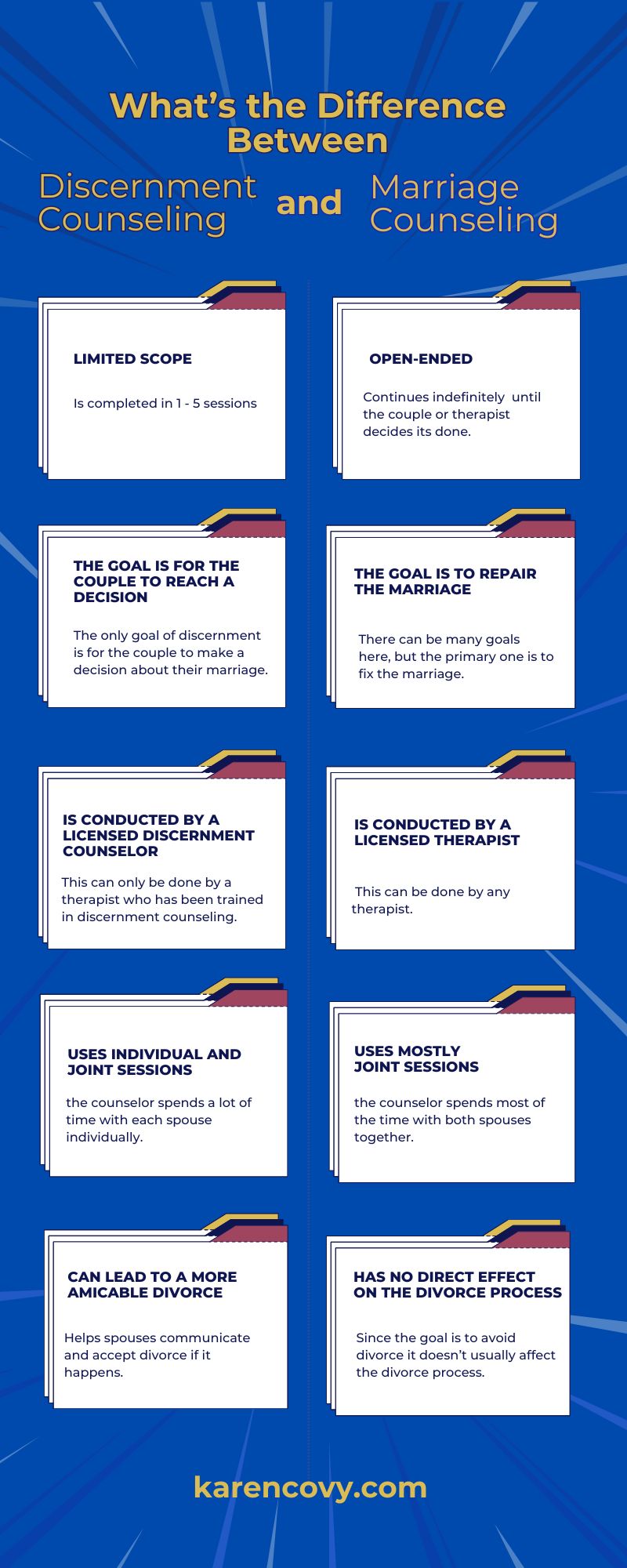
Going to marriage counseling requires an open-ended commitment to talk about, and work on, your marriage. That commitment can last for months – or even years!
Discernment counseling, on the other hand, is totally different. It's what is known as “limited scope” counseling. That means it only lasts between 1 – 5 sessions. After that, a couple has made one of the only three decisions possible in discernment counseling:
- To stay married and to go to marriage counseling for at least 6 months to work on their marriage;
- To get divorced; or
- To do nothing and stay locked in indecision.
Discernment counseling is typically conducted in 1½ to 2 hour sessions. During each session the therapist will usually work with each spouse individually and with both spouses together.
In the discernment counseling process, the therapist works to help each spouse get clarity about:
- What happened to their marriage;
- What role they played in bringing their marriage to this point; and
- What they want to do about their marriage in the future.
As clinical psychologist and certified discernment therapist Dr. Ginny Wright explains:
"Discernment counseling is a very short term, very focused service specifically for those couples (where one spouse is 'leaning out' of the marriage and the other is 'leaning in.") It is not designed to fix their marriage, because 50% of them don't really want to fix the marriage, at least at this point, but to help them decide if they want to try to fix the marriage."
In short, marriage counseling is designed to help you work on your marriage. Discernment counseling is designed to help you make a decision about your marriage.
What's the Difference Between Discernment Counseling and Decision-Coaching?
Both discernment counseling and decision coaching are designed to help someone reach a decision about the future of his/her marriage with confidence and clarity. Each process, however, achieves that goal in slightly different ways.
The primary difference between discernment counseling and decision coaching is that discernment counseling is done with couples. If both spouses don’t agree to go to discernment counseling, it doesn’t happen.
Decision coaching, however, is done with an individual. It doesn’t require both spouses to agree to attend.
That can be both positive and negative.
It’s positive because you can do it yourself. You don’t need to rely on your spouse for anything. As a matter of fact, you can go through decision coaching without even telling your spouse you’re contemplating divorce.

On the other hand, because you are going through the decision-making process yourself, the decision you reach will necessarily be YOUR decision. That can make it more challenging for your spouse to accept. (Although, a good decision coach will coach you about how you can break the news to your spouse in the way that is least likely to cause conflict and bitterness.)
Another difference is that discernment counseling is typically done by a therapist. It’s designed to help each spouse explore the role s/he played in getting their marriage to the brink of divorce. In other words, discernment counseling focuses on the past.
Decision coaching, on the other hand, focuses on the fugure. It's conducted by a coach rather than a therapist. It's designed to help you make a decision that you can feel comfortable with about your marriage so that you can move forward in peace, regardless of what caused your marriage to get to the point where it's at now.
What’s more, decision coaching does more than help you just make a decision. It also helps you create a plan for moving forward with that decision so that you can create a life you love in the future.
(To learn more about decision coaching, how it works, and how it can help you, click the button below.)
What if I Want a Divorce but My Spouse Wants to Stay Married? (Or Vice Versa)
No form of coaching, counseling, or therapy can keep a couple together when one spouse is determined to divorce. But, until at least one spouse is committed to ending their marriage, there’s space to work on the marriage, even if that space is incredibly small.
In that tiny space, discernment counseling can often have a much bigger impact than marriage counseling.
Why?
#1. It's shorter.
It’s often difficult to get a spouse who’s leaning out of the marriage to commit to spending months or years in open-ended marriage counseling. They see the counseling process as being long and painful. Since they’re not even sure that going through that painful process will make a difference in their marriage, they often aren’t willing to try it. (Or, to try it again!)
Discernment counseling, on the other hand, is time-limited. That, in and of itself, may convince a spouse who’s “leaning out” of their marriage, to try it.
#2. It has an objectively identifiable goal.
Unlike marriage counseling, discernment counseling has a clear objective: to make a decision.
At the end of your discernment counseling process you and your spouse have either made a decision, or you haven’t. The results are clear and easy to measure.
Marriage counseling, on the other hand, doesn’t have an objective that is as clear as discernment counseling. When marriage counseling is over, a couple can’t always tell whether it was successful or not.
For example, when you and your spouse stop going to marriage counseling you may still be together … but was that the only goal? Are you happy? Is your relationship obviously better? And, if it is better, will it stay that way?
Those are all difficult questions to answer, They’re also very subjective. That makes the outcome of marriage counseling much more murky than the outcome of discernment counseling.
Who Should NOT Use Discernment Counseling

Even though discernment counseling can be an amazing tool, it’s not for everyone. More specifically, it's not for:
#1. Couples where one spouse has already decided s/he wants a divorce.
If you (or your spouse) has already decided for sure that you want a divorce, then going to discernment counseling makes no sense. You already know your marriage is over.
Discernment counseling is not a place where you go to “let your spouse down easy” simply because you don’t have the guts to tell the truth.
Another benefit of discernment counseling is that can help you and your spouse start to heal even before your divorce has even started. It can give the two of you a safe space to talk about the way you want to go through your divorce so that it’s less destructive and less painful.
#2. Marriages involving domestic violence.
If you have been the victim of domestic violence or if your spouse is threatening you in any way then discernment counseling is not going to be appropriate for you.
Does Discernment Counseling Make Sense for You?
If you’re stuck in indecision, struggling to decide whether to stay married or get a divorce, discernment counseling can be a Godsend. It can help you and your spouse take stock of your marriage, figure out what went wrong, and decide whether or not you want to try again.
Discernment counseling can help even when you and your spouse have totally different ideas about what to do with your marriage. It’s a perfect tool to help you and your spouse assess your marriage when one of you is leaning toward trying to save the marriage and the other is leaning toward divorce.

At the same time, even though discernment counseling can be very effective, going through it is still not easy.
Deciding whether to end your marriage – especially a long-term marriage – is never easy no matter how you do it.
Yet, spending your life on the fence isn’t easy either.
A good discernment counselor can help you and your spouse get "Off the Fence" so you can get on with your lives.
_________________
This article was originally published in September, 2015 and updated on September 23, 2024.
About Karen Covy
Divorce Coach, Decision Coach & Lawyer
Karen Covy is a divorce coach, decision coach, and lawyer who has been helping people navigate through divorce for over 30 years. She is the author of "When Happily Ever After Ends" and the host of the Off the Fence podcast.
Learn more about KarenReady to Take the Next Step?
Get personalized guidance to navigate your divorce with clarity and confidence. Schedule a free consultation with Karen today.