Should I Get a Divorce? 15 Signs That Your Marriage is Over

“Should I get a divorce?” If that question has popped into your head, your marriage is already in trouble. Yet, just because you're thinking about divorce that doesn't necessarily mean you're going to get one. On the other hand, it's definitely one of the signs that your marriage is over ... or close to it!
The truth is: deciding whether to divorce is huge. Making that decision can tie you up in knots for months, if not years. Meanwhile, the conversation in your head tends to go something like this:
I know that marriage isn’t always easy. Everyone has their ups and downs. Yet, it seems like all we’ve had is “downs” for a long, long time!
Should I stay married for the kids? Will they be better off? Or, is staying together worse for the kids?
What if I stay and nothing changes?
What if I leave and I find out I made a mistake?
Or, what if I leave and then I end up being alone for the rest of my life? What if no one ever wants me?
Dazed and Confused: Should I Get a Divorce or Not?
If that conversation sounds like one you’ve been having with yourself, don’t despair. The very fact that you’re still struggling means that your marriage isn’t over yet. On the other hand, you are not exactly swimming in marital bliss either.
What is important is that you recognize the reality of what you're dealing with. Denial is not your friend.
So, where are you at when you’re not happily married, but you’re not ready to get a divorce either?
Well, in a word, you’re miserable! But how do you know if your misery is “normal” or whether you’ve crossed the line and will soon be facing divorce?
Here are some sure-fire signs that your marriage is over (or in serious trouble!).
Signs Your Marriage is Over
1. You are constantly criticizing each other.
It’s normal not to agree with your spouse about everything. But when your disapproval changes from just disagreeing about what you like or want, to disapproving of your spouse as a person, your “disapproval” has turned to criticism.
Being too critical can be lethal in a marriage.
When you and your spouse start criticizing each other you focus on everything that’s WRONG with each other. You focus on what’s wrong in your relationship. When you do that, you start to forget what’s RIGHT about your relationship.
While criticism alone might not be a sign that you need to divorce, it paves the way for even more damaging behaviors. Plus, when criticism becomes a constant companion in your marriage, you open the door for the biggest marriage killer of all: contempt.
2. Respect is out. Contempt is in.
Mutual respect is the foundation for every healthy relationship. Once you lose respect for your spouse (or vice versa), your marriage WILL start to go downhill. Why?
... because when respect leaves your marriage, contempt creeps in.
Contempt is criticism on steroids.
When you hold someone in contempt, you despise them. When you hold your spouse in contempt, you can't stand him/her. Once you feel that negative about your spouse, it won't take long for your marriage to completely dissolve.
According to world-renowned marriage specialist Dr. John Gottman, contempt is the single greatest predictor of divorce. If left unchecked, contempt will destroy your marriage. Period.
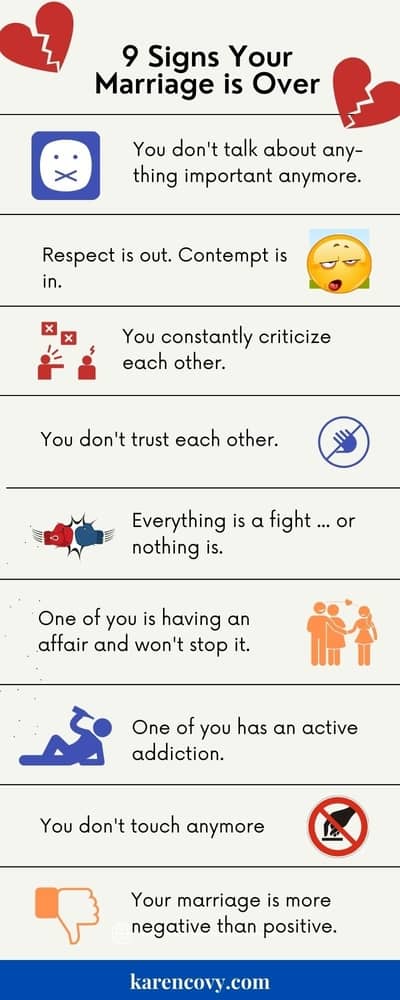
3. You don’t trust your spouse anymore (or your spouse doesn’t trust you!).
According to Stephen Covey, trust is the foundation that holds all relationships together. If you don’t trust your spouse, you can’t feel safe in your marriage. If you don’t feel safe, you’re not going to have much of a marriage.
Lack of trust can come in many sizes and shapes.
There’s the lack of trust that comes when your spouse doesn’t do what s/he says s/he is going to do. There’s the lack of trust that comes when you or your spouse is overly possessive or jealous of the other. And then there’s the lack of trust that follows an affair.
While a lack of trust can destroy your marriage over time, the good news is that trust is something that you can rebuild. It takes time, energy and commitment. But a lack of trust, in and of itself, does not have to be a sign of divorce.
4. You don’t talk any more.
Not everyone talks a lot in relationships. As a general rule, women tend to talk more than men. Extroverts tend to talk more than introverts.
But when one person in a marriage refuses to talk to the other at all, s/he is “stonewalling.” Unfortunately, stonewalling is one of what Dr. Gottman describes as “the four horsemen of the apocalypse” in a marriage. It is a marriage killer.
The partner who stonewalls is usually responding to his/her spouse’s criticism or contempt. What happens is that spouse A (let’s say the wife) starts criticizing spouse B (the husband). The husband then defends himself. But after he’s been criticized too much and for too long, he stops defending himself and starts simply ignoring his wife.
That, in turn, makes his wife become even more critical. She goes after her husband even more. So, he talks even less. And on and on it goes, until the couple isn’t talking at all. That lack of communication leads to even more arguments, criticism, and defensiveness. Eventually, all of this unproductive behavior can lead to divorce.

5. Everything is a fight … or nothing is.
When you and your spouse start to fight all the time about everything, your marriage is in serious trouble. No one wants to live in a constant state of agitation. What may be less obvious, though, is that NOT fighting can be just as deadly to your marriage as constantly quarreling.
If you and your spouse never disagree about anything, chances are you’re not being honest with each other. That lack of honesty will eventually eat away at the insides of your marriage. When that happens your marriage – which may have looked perfect on the outside – implodes from the inside.
Another sign of divorce can be the WAY that you fight.
If you and your spouse are able to respect each other even when you disagree about something and even when you’re fighting, your disagreements can be healthy. But when you start making your disagreements personal, your fights become damaging. Those personal fights are what hurt your marriage.
6. One of you is involved in an ongoing affair.
Contrary to popular opinion, marriages CAN survive an affair. But few marriages can survive when one partner is having an affair that s/he refuses to end.
Most people think that an “affair” is defined as having sex with someone who is not your spouse. But defining “an affair” as sex misses the point.
The essence of an affair is not simply sex. It’s betrayal – a betrayal of trust. Even if your spouse is having an “emotional affair,” if s/he refuses to end it, your marriage will suffer. You can’t rebuild trust when your spouse continues to violate the boundaries of your marriage.
If your spouse refuses to end his/her affair, s/he is essentially saying that s/he cares more about his/her affair partner than about you. The same thing is true if your spouse is a serial cheater. Unless your spouse is willing to commit to you and you alone (or unless you’re willing to share!) your marriage is not likely to last.
7. Your spouse is abusive:
a. Physically – Physical violence is never okay. Ever. If your spouse is physically abusing you or your children, you need to leave. You need to get to a safe space. After you do that, you need a divorce. Period.
b. Emotionally – Emotional abuse may not be as obvious as physical abuse. But it can be just as damaging. If your spouse is always yelling at you, belittling you, and making you feel like dirt, that’s a BIG sign that your marriage is in trouble. You need to either get into some serious marriage counseling or start thinking about divorce.
c. Financially – The most overlooked kind of abuse is financial abuse. Financial abuse can be direct, i.e. your spouse controls all the money and won’t give you any. Or financial abuse can be indirect, i.e. your spouse gambles away everything you have. Both can be devastating to your relationship.
If your spouse is abusive and refuses to change, that’s a definite sign that you may need a divorce.

8. One of you is addicted to drugs, alcohol or something else that’s destructive.
Being married to someone who has an active addiction is really hard. It doesn’t matter whether the addiction is to drugs, alcohol, gambling or porn. Even the strongest marriage can be challenged by any kind of uncontrolled substance abuse.
The good news is that if an addicted spouse is willing to work on his/her addiction, s/he can recover. Usually, that recovery also helps repair their marriage. So just because your spouse has an addiction of some sort doesn’t mean you automatically need a divorce.
However, the road to recovery can be long and hard.
If you’re married to someone who has an addiction issue, you either have to be down with hanging in for the long haul, or you need to re-think your marriage right now. (And, of course, if your spouse won’t admit s/he has a problem, or won’t get help, their recovery – and your marriage! -- becomes impossible.)
9. You can’t stop thinking about life without your spouse!
Anyone who’s been married for any length of time has occasionally wondered about what life would be like without their spouse. It’s only human to think about what you don’t have. What makes those mental machinations cross into the danger zone is their frequency.
Happily married people do not spend their time contemplating divorce.
Sure, everyone wonders sometimes if the grass wouldn’t be greener with someone else. But, for happily married people, the random thought of divorce is exactly that: random. It doesn’t last.
Thinking about divorce often, or constructing elaborate daydreams about what your life as a single person would be like, is a definite sign that your marriage is in trouble. (HINT: If you’ve gone so far as to have already made an exit strategy, that is a serious sign of divorce!)
10. You and/or your spouse insists on playing the “Blame Game”.
A good marriage requires good communication. But you can’t have good communication when you and your spouse are slinging accusations and blame at each other.
Blame kills real communication. When one spouse starts blaming the other for something, it’s only natural that the blamed spouse will start to feel angry and defensive. S/he may then start blaming the accusing spouse. Soon, both spouses are arguing about how the other person is wrong, rather than talking about whatever the real issue is.
What’s more, once you and your spouse are locked in a blame battle, you stop communicating. You are both focused on making your points. Neither one of you is listening to the other. You’re no longer talking to each other. You’re just yelling at each other. That’s not productive.
Obviously, not every communication a married couple has is going to be peaceful and perfect. Sometimes we all want to blame our spouses (rightly or wrongly) just because we’re mad! But when blaming becomes the “go-to” way to have conversations in a marriage, that’s a sure sign that that marriage is in trouble.
11. You don’t touch anymore.
Intimacy is a huge part of marriage. It was what makes marriage different than friendship. When you and your spouse are no longer physically intimate with each other, your marriage suffers. (That is, of course, assuming that you both want to have sex, or want to have it more often.)
Your marriage suffers even more when you and your spouse stop touching each other completely.
Human beings need touch to survive. That touch doesn’t necessarily have to be sexual. Hugging, shaking hands, touching each other’s shoulder, all count. They are all forms of communication and expression.
If you and your spouse haven’t touched each other in years, that’s definitely a sign that you’re headed toward divorce.
12. You’ve got a deal-breaker issue that you can’t resolve.
Most issues that come up in a marriage can be fixed. Deal breaker issues can’t be fixed. There is no real compromise. They are all or nothing propositions.
For example, does your husband insist on throwing his underwear on the floor by the bed every night? You can work on changing that. Does your wife insist on talking to you when you’re totally exhausted and can’t even think straight? You can work on changing that.
But, do you desperately want children while your spouse is adamantly against it? Are you trying to blend your families, but your kids HATE each other and nothing seems to help? THOSE are deal-breaker issues. (You can’t have a baby and NOT have a baby at the same time. You can’t have a happy blended family when your kids won’t co-operate.)
Not every important issue in a marriage is a deal-breaker issue. But if you and your spouse have a real deal-breaker in your marriage, and one of you is not willing to give in to the other, that does not bode well for the future of your marriage.

13. You can’t remember the last time you were happy.
No one is happy all the time. But we all like to be happy at least some of the time.
If you can’t even remember the last time you were happy in your marriage, that’s a problem. It’s even worse if your unhappiness has grown into anxiety or depression.
If you find that you’re constantly sick or depressed all the time (and you didn’t tend to be sick or depressed before you were married) that may be a sign that something is off in your marriage.
At the same time, you don’t have to be diagnosed with depression to be unhappily married. If you can’t remember the last time you laughed, or had FUN, with your spouse, that’s a sure sign that your marriage is in trouble.
14. Your marriage is more negative than positive.
Every marriage has its ups and downs. No one is blissfully happy all of the time. (That is, of course, unless you’re a highly evolved Zen master … in which case you’re probably not married anyway!) But if the negative experiences with your spouse far outweigh the positive ones, your marriage is in trouble.
According to science, a happy relationship has five positive interactions for every one negative one. That means that for every negative interaction you and your spouse have while you are “discussing” something, you have five positive ones.
(NOTE: It doesn’t matter how big or small your interactions are. Ten small negative interactions don’t necessarily get wiped out by one big positive one.)
The good news is that, like so many other signs of divorce, negative interactions can be changed. With time, effort, and a good marriage counselor, you and your spouse can turn your negatives into positives.
15. One of you isn’t willing to work on the marriage.
As the saying goes, it takes two to Tango. If you want to work on your marriage but your spouse doesn’t, you’re not likely to improve anything.
Of course, it’s also true that if you work on yourself, that will change your marriage. For example, if you’ve always had a problem with your temper, and you go to anger management classes and learn to control it, you may have more peaceful interactions with your spouse.
But if your spouse doesn’t care, it doesn’t really matter.
There is such a thing as the “point of no return” in a marriage. If your spouse has crossed that point, your marriage is over. Nothing you can do will change that. Sadly, if your spouse isn’t willing to work on your marriage, that’s a big sign that they’re done with it.
(NOTE: There is a HUGE difference between not being willing to work on a marriage, and not being willing to go to marriage counseling. For whatever reason, LOTS of people don’t want to go to marriage counseling. BUT they may be willing to do something else to save their marriage.)
What Do You Do When Your Marriage is in Trouble?
If you recognized that your marriage has one or more of these signs of divorce the obvious next question is: What do you do about it?
It’s all well and good to have confirmation that your marriage is a mess. But chances are, you already knew that anyway.
The bigger problem is that saying “YES” to the question, “Should I get a divorce?” isn’t easy!
Thankfully, today you have lots of options that will help you know whether you should stay or go. Here are some of the most important ones:
5 Tools to Help You Know Whether You Should Get a Divorce
1. Marriage Counseling.
Marriage counseling can be one of the most effective tools for turning your marriage around. It can help you and your spouse improve your communication, deepen your intimacy, and resolve any long-standing disagreements you have.
If your marriage is in trouble, you owe it to yourself, your spouse, and your kids, to figure out whether there is something you can do to save it. Marriage counseling is one of the best places to start.
Traditional marriage counseling is an open-ended process in which you and your spouse explore your issues and work with a marriage counselor to make them better. The focus of marriage counseling, though, is typically on saving your marriage, NOT on helping you decide whether you want to save your marriage.
Even still, marriage counseling can help get you clarity around whether you really want to stay married or get a divorce. If, after trying marriage counseling for months or years, things aren't getting any better, that may be a sign that getting a divorce is an option you should consider.
2. Pastoral Counseling.
Most organized religions, even those which do not recognize divorce, often have programs which are geared towards helping couples improve their marriage. Depending upon your religious affiliation, you may have any one of several kinds of marriage help available to you.
Some churches offer marriage retreats, where you and your spouse spend a concentrated period of time together working on your marriage. Others offer marriage encounter weekends that are similar to retreats but only last for a weekend. Others offer weekly marriage programs, where various couples come together to work to improve their marriages.
Some ministers, priests, rabbis and church leaders offer one-on-one marriage counseling. In that respect, they act much like a traditional marriage counselor.
If you are trying to save your marriage, any of these programs can be very helpful.
On the other hand, any faith-based program is going to focus on saving your marriage. If you're trying to decide whether to get a divorce, these kinds of programs can actually make your decision harder. That’s because many of them will add a layer of shame and guilt into your decision-making process that you might not have otherwise had to deal with.

3. Discernment Counseling.
Discernment counseling is a new type of counseling pioneered by therapist Bill Doherty. He developed discernment counseling as part of the Minnesota “Couples on the Brink Program.”
Unlike marriage counseling, the focus of discernment counseling is NOT on saving your marriage. It is on getting you and your spouse clear about whether or not you want to stay married.
Also, unlike marriage counseling, discernment counseling is not open-ended. It is most often conducted in approximately 4 - 5 sessions. After that, you and your spouse will likely either be committing to a six-month course of marriage counseling where you can work on your marriage, or you will start talking seriously about divorce.
Discernment counseling is the only type of counseling that is specifically designed to help you and your spouse make a decision about your marriage.
4. Trial Separation.
A trial separation is another technique that’s theoretically designed to help you and your spouse figure out whether or not you want to stay married.
A trial separation gives you and your spouse space and time away from each other in a very controlled situation. In a true trial separation, you and your spouse actually lay out the rules of your separation in a written agreement. (Usually, a divorce coach or counselor helps you write that agreement.)
The trial separation agreement sets the guidelines for how long the separation period will be. It also says what you and your spouse will do during the separation period. (e.g. Will you go to marriage counseling during that time? Can you date other people while you’re separated? Who pays the bills while you’re separated? etc.)
Trial separations can be incredibly helpful when you and your spouse are fighting so badly that you can’t even THINK about your marriage. They can give you and your spouse some space and time to figure out what you truly want.
On the other hand, trial separations can also make your relationship even worse if they're not done properly.
For example, if you or your spouse just storms out of the house in the middle of a fight saying, “I’m outta here!”THAT kind of "trial separation" is not likely to go well. Chances are, you and your spouse won't communicate much while you're separated. When you do, you'll just keep having the same fights you always had. All of that only leads to more mistrust and misunderstanding.
The net result is that your "trial separation" becomes more of a "trial divorce" than anything else.

5. Decision Coaching.
Unlike marriage counseling, which is designed to help you save your marriage, decision coaching is designed to help you make a decision about whether you want to save your marriage. The focus of decision coaching is solely and completely on getting you clear about what you want and why you want it so that you can make a decision about your marriage that you feel good about.
In decision coaching, you won't be pushed to stay married. You won't be pushed to get a divorce. You will simply be challenged to do one thing: Make a decision.
Decision coaching is different from discernment counseling in that discernment counseling requires both you AND your spouse to participate in it. Decision coaching is done with you as an individual. It helps you get clear on what YOU want before you involve your spouse in any decision-making process.
Decision coaching is based on brain research, neuroscience, and the science of decision making. It uses tools and techniques that help you stop spinning in your head, so that you can actually make progress in your marriage and in your life.
(If you're interested in learning more about decision coaching and exploring whether it could work for you. CLICK HERE and connect with me.)
Give Yourself Permission
Deciding whether to divorce is life-altering! No matter how many signs that your marriage is over are staring you in the face, it’s still YOUR marriage! It’s your life! Changing it is hard!
If you decide to stay married, you’ve also got to decide what you’re going to do to make your marriage better. Otherwise, you'll be stuck in the same situation you're in right now. (And, let's face it. If your marriage was good, you probably wouldn't be here reading this article right now!)
If you decide to get a divorce, you’ve also got to figure out what your next steps are. In other words, you need a plan.
Why?
Because unless you have a plan, and unless you start taking steps to implement that plan, you can easily fall back into indecision.
The truth is for most people, especially those who are in long term marriages, figuring out whether and how to get a divorce can be overwhelming. That's why getting professional help from a therapist or a coach can be so important.
If you're scanning your marriage looking for signs that it's over, and struggling to decide whether to get a divorce, do yourself a favor. Get help. Working with a divorce professional can save you years of angst and misery.
Meanwhile, be kind to yourself.
Give yourself permission to feel what you feel, to choose what seems right for you, and to make mistakes along the way.
Step by step, you will work your way through to the point where you have an answer to the question, “Should I get a divorce?” that rings true for you.
_______
This article was originally published in January, 2015 and most recently updated on January 17, 2022.
Frequently Asked Questions
How do I know if I should get a divorce or stay married?
What are the signs that a marriage is over?
Should I stay in an unhappy marriage for the kids?
What alternatives to divorce should I consider first?
Can a trial separation help me decide about divorce?
How long should I wait before deciding to divorce?
Is it normal to feel guilty about wanting a divorce?
About Karen Covy
Divorce Coach, Decision Coach & Lawyer
Karen Covy is a divorce coach, decision coach, and lawyer who has been helping people navigate through divorce for over 30 years. She is the author of "When Happily Ever After Ends" and the host of the Off the Fence podcast.
Learn more about KarenReady to Take the Next Step?
Get personalized guidance to navigate your divorce with clarity and confidence. Schedule a free consultation with Karen today.